|
|
 |
|
Here's the latest on space, and my opinions on it... This is the legacy site, with blog
entries from November, 2004 through June, 2011. Updates after June 9, 2011 can be found at http://spacewhatnow.com/SWN
|
|
|
|
Wednesday, January 28, 2009
Anniversary Week
If I were superstitious, I'd try to assign a lot of importance to the fact that NASA's three big space disasters: Apollo 1, Challenger, and Columbia all happened between 27 Jan and 1 Feb. Take a moment to remember the losses, then work to learn the deeper lessons and
move humanity forward.
Tuesday, January 27, 2009
Earth-Follower Asteroid
2009 BD is a recently-discovered asteroid that, according to the JPL orbit model, nearly orbits with Earth, passing close by every
90 years or so. I'm doing some more research with the Horizons system, which is more accurate, but not as user-friendly as the orbit visualizer. News article here.
8:38 pm est
Friday, January 23, 2009
More Detailed View of 20 Jan
I'm still trying to figure out the best way to get the Landsat images posted, but in the meantime, check out this one which is getting more press for an obvious reason. Note the slight fuzziness near the capitol due to some high cloudiness.
Solar Storms Effects Report
Our sun is quite active, at times belching out huge clouds of charged gas, x-rays, or a mix of a whole bunch of bad stuff.
Sometimes, those ejecta effect Earth. There are archives of solar storms over the last 150 years. Two notable ones I've heard of were the 1989 storm that caused a blackout in Quebec
and one of the 1882 storm that caused fires at the ends of telegraph lines. Our world is much more wired now, and much more
dependent on electricity. Turns out that it's the 'wiredness' that gets us, as detailed in this article and linked report.
Tuesday, January 20, 2009
Landsat 5 Images DC Today
As the United States turns a new page in its history, a spacecraft that's been imaging the country for nearly 25 years flew
overhead and took a picture of the Nation's Capitol. The first January it imaged was in 1985. I'll post some pictures from
it soon, but in the meantime, you can check them out yourself.
Landsat 5...imaging from Reagan through Obama. The plan is for it to image near another one of these events as well.
Saturday, January 10, 2009
Entering the '00s
Well, I've finally activated a Facebook page for yours truly. I wanted to put a link to it up, but I haven't figured out
their addressing. Turns out there are 500 "Tom Hills" out there, so I can't just say 'search for me.' The page came in response
to the TEMPO page created to support the project. TEMPO also has a presence on Twitter, which means I'll have to come up with something short and witty to say every day or so, I guess. Twitter seems like overkill
for a project in development. I could see it as useful for a satellite that's flying, sending updates about which countries
it's flying over and the like, but we'll have to see.
Travelin' for TEMPO³
9:55 pm est
Monday, January 5, 2009
Mark your Calendars!
6:53 pm est
Sunday, January 4, 2009
On the Air
4:12 pm est
Saturday, January 3, 2009
5 Years?
I'm trying to figure out where the five years have gone since the Mars Rovers started their explorations of the Red Planet. I gave a talk at the local library, right after Opportunity landed.
A lot of people attended, and the librarian said I should come back "Maybe after the mission is over."
Guess I should have picked another topic...
Friday, January 2, 2009
New Year, New Space Controversy
Via Space Politics comes a half-baked article about The Obama Administration "tearing down the walls" between NASA and the DoD with the possibility of NASA using the Delta
IV and Atlas V to loft NASA's manned spacecraft.
The thing is, it would be possible to use Evolved Expendable Launch Vehicles (EELVs, the original name of the Delta IV and
Atlas V rockets) to loft manned payloads. The original idea of the EELV program was to launch the then-planned thousands
of satellites (remember, during the heady days of the mid-90's everyone had a satellite program...) at unheard of launch rates.
If NASA's Ares rockets were changed out with the EELVs, the necessary launch rate to put people on the moon and send us to Mars would be
huge. This number of launches required per lunar or Mars mission is often cited as a reason why we can't use EELVs. The
missing piece of information in that argument is that multiple launches would drive different mission designs, including such
things as supply depots and modular spacecraft. Such an approach would make for a much more flexible missions.
Another point brought up is the idea of blackout zones, where a launch vehicle's trajectory leads to portions of the flight
path where crew escape is impossible, difficult, or challenging depending on who you talk to. I don't know enough about the
flight profiles to comment intelligently (plenty of other people don't let a lack of knowledge stop them) on that.
|
|
|
|
|
|
|
|
|
Space: Search Now! with Google
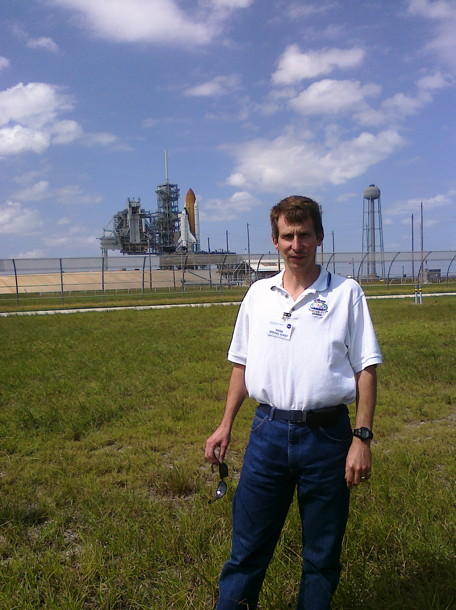
| Tom and Discovery |
|
| Taken During a Tour of KSC on 6 Oct 2010 |
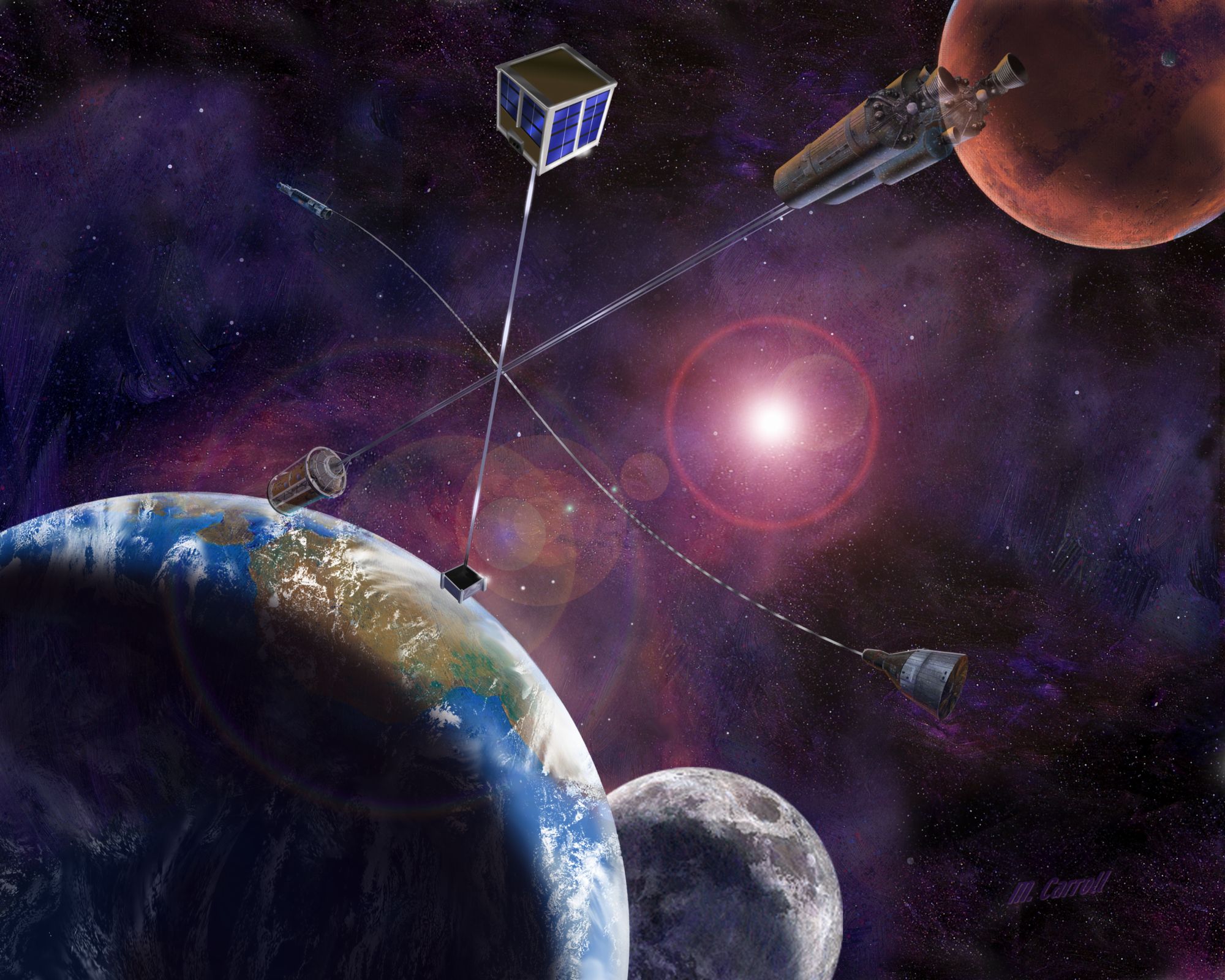
| TEMPO³ Update |
|
| Click on the picture to go to the Mars Society TEMPO³ Page |
| Solar System Ambassadors |

|
| Click on the image above to see Tom's SSA profile |
Email Comments to tom [at]
spacewhatnow.com
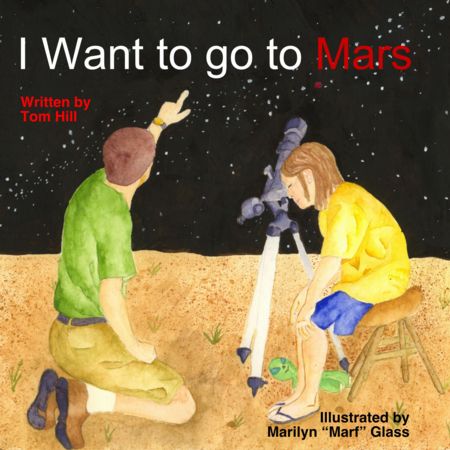
| Latest book! Click on the cover to purchase |
|
| I Want to go to Mars is a picture book for beginning readers |
More information on I Want to go to Mars can be found in the devoted section of this web site.
Join the Space:What Now? email list for updates on book events or articles published by the author. Email
addresses will not be shared.
I kind of wrote this off, thinking I was being spammed, but I'd like to know if people are really signing up. Please enter
the text you see below in the second line, and I'll get a warm, fuzzy feeling that people are actually reading and signing
up for mail!

| Now Available! |
|
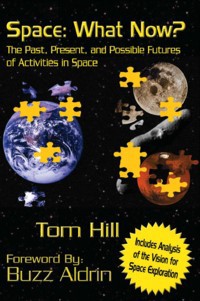
| Clicking here will take you to purchasing options for SWN |
| Get your SWN Gear! |
|
|
| Powered by CafePress |
|
|
|
|
|
|
|
Scotty
The Updated Past, Present and Possible Futures of Space Activity
|
|
|
|